Table of Contents
Introduction
You’re staring at Systeme.io trying to figure out if you should promote it or use it.
That’s the question everyone asks when they first uncover this platform. Should you earn commissions sending people to Systeme.io, or should you build your actual business on their infrastructure?
The choice matters more than you think. One path generates passive income from other people’s subscriptions.
The other gives you the tools to build and scale your own products.
Most people waste weeks trying to decide. Let me break down exactly what each option delivers so you can make this decision today instead of next month.
Systeme.io Affiliate Program vs Systeme.io Website Builder: The Money Breakdown
When you compare systeme.io affiliate program vs systeme.io website builder financially, you’re looking at two completely different revenue models.
The affiliate path costs nothing upfront. You keep a free account and promote paid plans. Your earnings grow as referral volume increases.
Someone with 100 active referrals on the Unlimited plan pulls in $5,820 monthly. That’s entirely passive if your promotional systems run without daily involvement.
The problem: Building referral volume takes months. You’re dependent on your ability to generate traffic and convert prospects into paying customers.
The builder path needs monthly investment. The free plan works for validation, but real revenue generation typically needs the Startup plan at least.
Over 12 months on the Startup plan, you’re investing $204 annually if you pay upfront. That’s less than one month of most email marketing platforms.
The return potential is substantially higher when you capture revenue directly from your own customers instead of waiting for affiliate commissions.
Real Success: How One Marketer Earned Millions in Affiliate Commissions
Some affiliates have built serious income with the Systeme.io affiliate program. The video below shows an experienced marketer explaining how he generated $2 million+ affiliate commissions using the platform’s recurring commission structure.
Not every affiliate will reach this level. But this example shows what’s possible when you apply the right strategies consistently.
The Specific Strategies That Worked
The marketer in the video used several key tactics that you can copy:
Building niche email lists came first. He didn’t blast Systeme.io links to random audiences.
He built targeted lists of people who needed the exact solution Systeme.io provides.
Creating educational content positioned him as an authority before he ever mentioned an affiliate link. He taught people how to build funnels, automate email sequences, and launch digital products.
Systeme.io became the natural tool recommendation.
Leveraging onboarding bonuses increased his conversion rates above typical referral numbers. He offered extra training, templates, and support to people who signed up through his link.
This gave them a reason to use his link instead of signing up directly.
Promoting recurring revenue tools aligned perfectly with lifetime commissions. He focused on getting people onto monthly plans instead of one-time purchases.
Each customer generated income month after month.
Using Systeme.io’s free plan for his own business meant he didn’t pay for the infrastructure to run his affiliate business. His landing pages, email sequences, and automation ran on Systeme.io’s free tier.
This eliminated overhead while he scaled affiliate income.
The platform made his work easier because everything connected. He didn’t manage five different tools. One dashboard handled everything from email to analytics.
Disclosure: DigitalToolsHub may earn a commission if you choose to sign up through our link. This does not affect our evaluations or recommendations.
When the Affiliate Model Makes Sense
The affiliate program works best in specific situations.
You already have an audience that trusts your recommendations. A consultant with 10,000 engaged email subscribers can promote Systeme.io to relevant segments and generate consistent monthly commissions without ever logging into the platform.
You run an agency and your clients need an all-in-one tool. Instead of recommending scattered solutions, you point them to Systeme.io through your affiliate link.
Some agency owners build six-figure annual income this way while continuing their normal client work.
You have strong sales and marketing skills but limited technical ability. Creating content, running ads, and building relationships needs different capabilities than setting up funnels and automation.
If you’re stronger at selling than building, the affiliate path removes technical friction.
You want to test income potential before committing to building a business. The affiliate program let’s you earn while learning whether the platform actually converts and keeps customers.
What You Actually Get With the Systeme.io Affiliate Program
The affiliate program pays 60% lifetime commissions. That means you earn 60% of whatever your referred customer pays, every single month, for as long as they stay subscribed.
Here’s what that looks like in real money. You send someone to the Startup plan at $27 per month.
You earn $16.20 every month that person stays.
If they stick around for a year, you just made $194.40 from one referral.
Now scale that. Get 50 people on the Webinar plan at $47 per month.
You’re pulling in $1,410 monthly in recurring income.
The commission structure beats most affiliate programs you’ve probably seen. The lifetime cookie means you get credit even if someone signs up for free today and upgrades six months later.
You still earn the commission.
There’s no least payout threshold. You earn $15 in commissions, you get paid $15.
The money hits your PayPal or bank account on the 10th of every month.
You don’t need approval to join. Create a free Systeme.io account, grab your affiliate link, start promoting. That’s it.
The catch: You need traffic to make this work. Without an audience, email list, or advertising budget, you won’t generate referrals.
The program is free to join, but driving traffic costs time or money.
What the Systeme.io Website Builder Actually Does
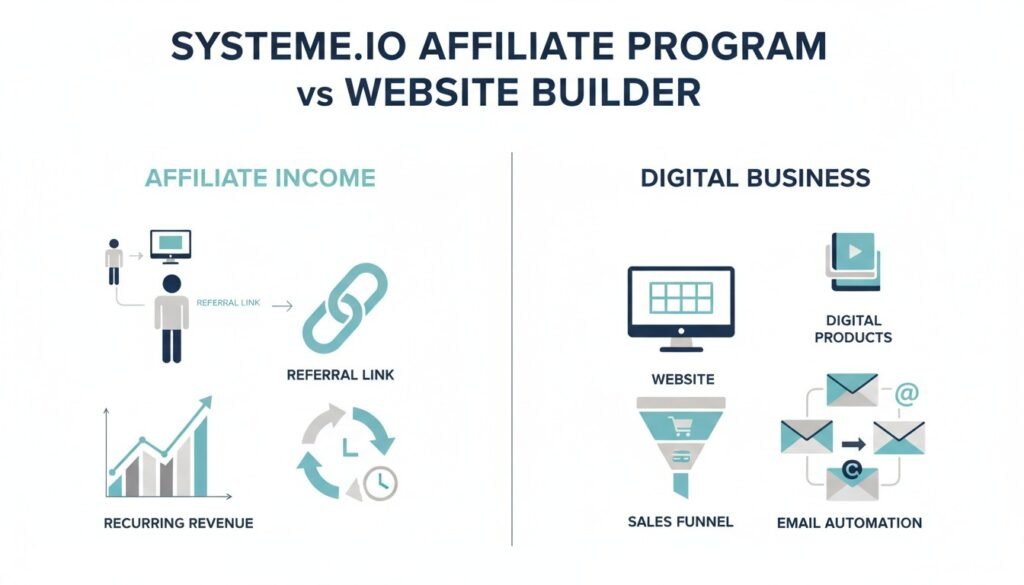
The website builder is part of a finish business platform. You’re not just getting a site builder.
You get email marketing, sales funnels, automation, course hosting, webinar tools, and payment processing in one dashboard.
The pricing starts at free. The free plan includes unlimited email sends to 2,000 contacts, three sales funnels, and basic automation.
For testing an idea or running a small operation, this covers your basics without spending a dollar.
The Startup plan costs $27 monthly (or $17 monthly if you pay annually). This gives you 10 sales funnels, 5,000 contacts, five automation workflows, and everything from the free plan.
The Webinar plan runs $47 monthly (or about $39 monthly annually). You get 50 sales funnels, 10,000 contacts, unlimited automation, and webinar hosting for up to 100 attendees.
The Unlimited plan is $97 monthly (or about $81 monthly annually). Unlimited contacts, unlimited funnels, unlimited everything.
This is where you scale without hitting platform limits.
You can build a functioning website in about 10 minutes. The templates handle design.
The drag-and-drop editor handles customization.
You don’t need coding skills or a developer on retainer.
The platform processes payments through Stripe and PayPal with zero transaction fees. Most platforms charge 2-3% on top of payment processor fees.
Systeme.io doesn’t.
When Building on the Platform Makes More Sense
The website builder path works better in different scenarios.
You’re launching a digital product business. The integrated course hosting, email marketing, and payment processing eliminate the need to connect five different tools.
Your product launches faster, and you keep 100% of customer revenue.
You’re moving from freelancing to productized services. Instead of trading hours for dollars, you build a course, template library, or membership site.
Systeme.io hosts it, markets it, and processes payments.
Your revenue scales with marketing effort instead of billable hours.
You operate an e-commerce business with digital components. The sales funnel builder let’s you create upsells, downsells, and order bumps.
These proven revenue multipliers stay out of reach for most solo operators because the setup complexity is too high.
Systeme.io makes it accessible.
You need to prove product-market fit before investing in expensive infrastructure. The free plan gets you started. The $17-27 monthly Startup plan scales you to 5,000 contacts.
You can validate your business without committing to annual contracts or expensive enterprise tools.
The Hidden Costs Nobody Talks About
The comparison between systeme.io affiliate program vs systeme.io website builder extends beyond monthly fees.
Affiliate costs hide in traffic generation. You need content creation, paid advertising, or list-building systems to generate referrals. A content-first approach needs months of consistency before returns appear.
Paid ads cut directly into commission earnings.
You’re learning to become a marketer and promoter simultaneously.
Builder costs hide in time and learning. You need to deliver value that justifies your price point. Your product needs to solve real problems.
Your marketing needs to convert cold traffic into customers.
The initial learning curve is steep.
However, once you understand your audience and refine your offer, improvements compound. Better copy increases conversion rates.
Better product delivery improves retention and referrals.
These multipliers don’t exist in pure affiliate models where earnings depend entirely on new referral volume.
Why Most Successful Operators Use Both
The smartest move is stopping the either/or thinking.
You launch a product using the Systeme.io website builder. You capture direct revenue from your audience.
As you build authority and accumulate case studies, you start recommending Systeme.io to complementary audiences through affiliate partnerships.
Now you earn in two directions: your product revenue and referral commissions.
An agency owner could build their service delivery infrastructure in Systeme.io while recommending it to clients as an affiliate. The platform pays for itself through client referral commissions while delivering their core service.
Someone with an email list could launch a free resource hub using Systeme.io’s free plan and recommend paid features to engaged members as they show value.
This approach addresses the biggest concern: upfront risk. You’re not betting everything on one strategy.
You test the platform with your own business while building referral channels simultaneously.
Exploring Systeme.io for yourself
If you want to understand how the platform works before deciding whether to promote it or build with it, you can explore Systeme.io’s free plan and see how the tools fit your workflow.
This allows you to evaluate the platform hands-on before committing to any strategy.
How the Two Paths Look at Scale
The comparison shifts once you generate substantial income.
An affiliate earning $10,000 monthly from 200+ referrals has mostly passive income. Time investment drops to maintenance level.
Monthly deposits arrive whether you work that month or not.
A builder running a digital product at the same revenue level handles ongoing customer support, product updates, and marketing campaigns. Time investment stays high.
But the builder’s revenue compounds differently. Better retention and upsells increase revenue without acquiring new customers.
The affiliate’s revenue stays flat unless referral volume increases.
An affiliate with 200 referrals earning $10,000 monthly stays at $10,000 if referral volume stops growing. A product business earning $10,000 monthly can often increase to $15,000 through better conversion rates, pricing optimization, or upsells without adding customers.
The psychological weight differs. Affiliate income feels safe but fragile.
You depend on Systeme.io’s continued viability and commission structure.
Product income feels risky initially but becomes progressively safer as you build a customer base and brand.
The Integration Advantage
What separates this comparison from similar platform choices: both paths work within the same tool.
You can test your business model without switching platforms later.
Start with the free plan using the website builder to validate your idea. As you grow, upgrade to Startup ($17-27 monthly) and eventually Webinar ($47 monthly) if you scale beyond 10,000 contacts.
Simultaneously, promote Systeme.io to relevant audiences as an affiliate.
You’re not wasting time moving between incompatible platforms or relearning interfaces.
This is why many operators report lower total cost of ownership with Systeme.io despite it not being the absolute cheapest option on paper. You’re consolidating tools, eliminating switching costs, and reducing learning curve friction that competitors impose.
| Factor | Affiliate Program | Website Builder |
| Upfront Cost | $0 (free account) | $0-97 monthly depending on plan |
| Income Potential | 60% lifetime commissions, scales with referrals | 100% of customer revenue, scales with sales |
| Time to First Dollar | 1-3 months building traffic/audience | 1-4 weeks with validated offer |
| Primary Skill Required | Traffic generation and promotion | Product creation and marketing |
| Passive Income Level | High once systems are established | Medium (requires ongoing support) |
| Revenue Ceiling | Depends on referral volume | Depends on market size and pricing |
| Best For | Existing audiences, agencies, consultants | Product creators, course sellers, e-commerce |
Making Your Decision Today
Your choice between systeme.io affiliate program vs systeme.io website builder depends on where you are right now and what resources you can deploy immediately.
Choose the affiliate program if you already have traffic, an engaged audience, or credibility in your niche. The 60% lifetime commissions compound over time, and the zero-cost entry minimizes risk.
You can start today without building anything.
Choose the website builder if you have a product idea validated by customer demand, or if you’re ready to build authority from scratch. The lower monthly cost compared to enterprise platforms, combined with integrated features, means faster time to first revenue.
Choose both if you want to maximize income potential. Use the website builder to generate direct revenue.
Use the affiliate program to monetize your authority and marketing efforts in complementary directions.
This changes Systeme.io from a single-purpose tool into a finish revenue engine.
Making the decision
Systeme.io removes most of the risk from this decision by offering a free plan. You can test the website builder, understand how the platform works, and decide later whether promoting it, building on it, or combining both strategies makes sense for your situation.
The Real Test
The best way to assess systeme.io affiliate program vs systeme.io website builder is through action instead of endless analysis.
The platform removes the financial barrier. Start today with a free account.
Test the website builder by creating a landing page and email sequence.
Grab your affiliate link and promote it to your existing audience.
Measure results in 90 days. Make strategic decisions from actual data instead of projections.
You’ll know within three months which path generates better returns for your specific situation. Some people uncover affiliate commissions exceed their product revenue.
Others find direct sales outperform affiliate income five to one.
The answer differs based on your audience, skills, and market position.
But you won’t find your answer by reading more articles. You’ll find it by building, promoting, and tracking what actually works.
The real competitive advantage comes from operators who stop treating this as an either/or decision. They build their core business on the platform while generating supplemental income from strategic referrals.
That’s how you maximize the total value Systeme.io delivers. Not by picking one path, but by running both simultaneously and letting real-world results guide your resource allocation.
For more enlightening posts like this, visit our blog page.