A Structured Framework for AI-Driven Marketing Workflows
This Ai tool adoption guide for marketing teams outlines a structured framework for AI adoption in marketing teams designed to increase speed without sacrificing clarity, governance, or brand alignment.
Table of Contents
Artificial intelligence is now embedded in everyday marketing operations. In 2026, AI tools are used for research, drafting, campaign planning, analytics, and internal communication. Yet many marketing teams still struggle to adopt AI in a way that improves clarity, consistency, and measurable output quality.
The challenge is rarely the technology itself.
Most AI platforms can generate summaries, drafts, and structured content within seconds. The real issue is adoption without structure. When AI tools are introduced informally—by individual team members experimenting independently—marketing outputs often become inconsistent, difficult to edit, and disconnected from brand strategy.
High-performing marketing teams take a different approach. They do not begin with the question:
“Which AI tool should we use?”
They begin with:
“Where in our workflow should AI assist, and where must human judgment remain central?”
That shift—from tool-first thinking to workflow-first strategy—is what separates teams that gain leverage from those that create complexity.
Why AI Adoption Fails in Marketing Teams
AI adoption often fails because workflows are undefined.
1. Inconsistent Brand Voice
When multiple team members use different tools with different prompts, outputs begin to vary in tone, terminology, and positioning. Over time, brand messaging drifts.
2. Repetitive Re-Editing
AI-generated drafts that lack structural guidance require heavy revision. Teams spend as much time correcting output as they would have writing manually.
3. Tool Overload
Marketing departments accumulate overlapping AI subscriptions without defined roles. This increases cost and complexity without improving efficiency.
4. Governance Risk
In B2B, technical, or regulated industries, uncontrolled AI use can introduce inaccuracies, compliance issues, and inconsistent terminology.
These problems are not caused by AI itself. They are caused by unstructured implementation.
The Shift from Tool-First to Workflow-First Strategy
Most teams treat AI adoption as a software decision:
- Which tool has the best features?
- Which platform is trending?
- Which automation looks impressive?
High-performing teams treat AI as a marketing operations decision.
Before selecting tools, they define:
- Messaging hierarchy
- Content lifecycle
- Approval workflows
- Documentation standards
- Team responsibilities
Only after clarifying these systems do they introduce AI into specific workflow stages.
This approach produces:
- Faster production cycles
- Reduced editing overhead
- Stronger brand consistency
- Clear accountability
- Measurable efficiency gains
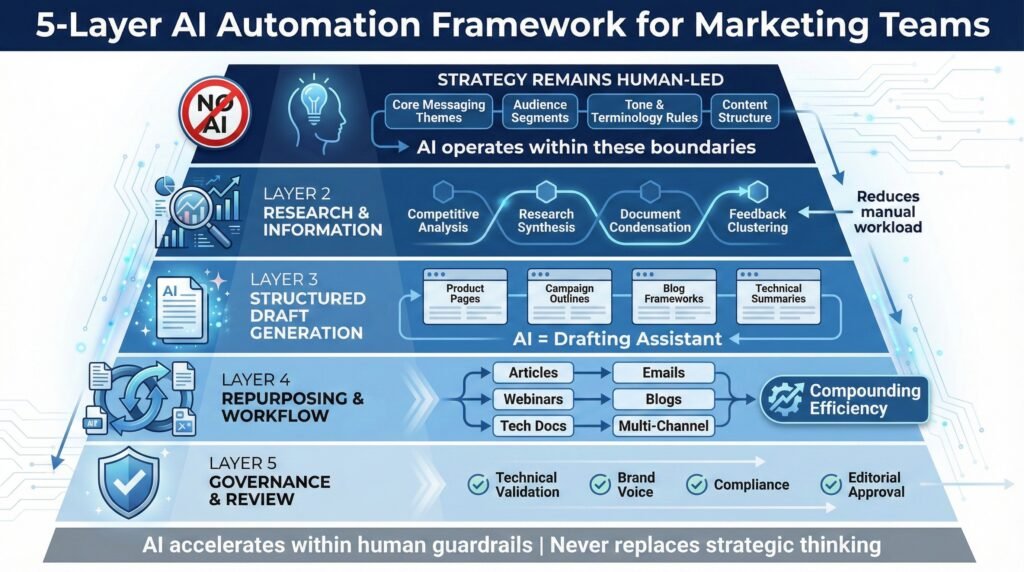
The 5-Layer AI Automation Framework for Marketing Teams
Layer 1: Strategy Remains Human-Led
AI does not define positioning, differentiation, or value propositions.
Marketing leaders define:
- Core messaging themes
- Audience segments
- Tone and terminology rules
- Content structure
AI operates within these boundaries.
Layer 2: Research & Information Structuring
AI can accelerate:
- Competitive analysis summaries
- Research synthesis
- Technical document condensation
- Customer feedback clustering
This reduces manual workload while preserving strategic oversight.
Layer 3: Structured Draft Generation
AI performs best when working inside predefined frameworks.
Instead of requesting open-ended content, teams should use structured prompts aligned to:
- Product page templates
- Campaign outlines
- Blog frameworks
- Technical summaries
AI becomes a drafting assistant—not a strategic decision-maker.
Layer 4: Repurposing & Workflow Automation
AI supports:
- Converting long-form articles into email campaigns
- Transforming webinars into structured blog posts
- Formatting technical documents for multiple channels
- Standardizing reporting outputs
This is where AI marketing automation generates compounding efficiency.
Layer 5: Governance & Review
All AI outputs should pass through human checkpoints:
- Technical validation
- Brand voice alignment
- Compliance review
- Editorial approval
Speed without review introduces risk. Structured review protects credibility.
A Practical AI Implementation Roadmap
Step 1: Audit Your Workflow
Identify bottlenecks in research, drafting, formatting, and reporting.
Step 2: Assign AI Roles
Define clear responsibilities such as:
- Research summarization
- First-draft generation
- Repurposing content
- Formatting structured assets
Avoid using one tool for every task.
Step 3: Build a Shared Prompt Library
Centralize prompts for:
- Blog drafts
- Product pages
- Email campaigns
- Technical summaries
This reduces tone drift across contributors.
Step 4: Standardize Templates
Consistency comes from structure, not software. Use standardized frameworks and messaging guidelines.
Step 5: Measure Performance
Track:
- Production time reduction
- Editing time reduction
- Campaign speed
- Output consistency
AI adoption should improve measurable KPIs.
Choosing AI Tools After Defining Workflow
Once workflow roles are defined, tool selection becomes straightforward.
Choose tools based on function:
| Workflow Function | Tool Category |
| Research & Summaries | AI chat platforms |
| Draft Generation | AI writing assistants |
| Workflow Automation | Integration tools |
| Project Management | AI-enhanced PM tools |
| Analytics & Reporting | AI reporting dashboards |
Use the tool finder below to identify solutions aligned with your team’s workflow.
Find the Right AI Tool for Your Workflow
Select your primary goal to discover which AI tool type fits your needs
Common Mistakes in AI Adoption
- Letting tools dictate workflow
- Using AI without shared standards
- Skipping human review
- Overloading the tech stack
- Treating AI as autonomous rather than assistive
AI works best inside defined systems.
Want to Turn AI Tools Into Income?
If you’re exploring AI tools not just for productivity but also for building digital income systems, you may want to explore structured AI monetization models.
AI Profits Sniper Overview outlines a beginner-friendly framework for using AI tools to create digital assets and income streams.
Key Takeaways
- AI adoption should start with workflow design, not tool selection.
- Structured frameworks prevent messaging drift.
- AI accelerates drafting, not strategic thinking.
- Shared templates reduce editing time.
- Human review remains essential for accuracy and credibility.
Final Thoughts
AI tools are most effective when they support clear systems rather than replace them.
The objective is not to automate thinking.
The objective is to remove repetitive effort so marketing teams can focus on strategy, clarity, and measurable outcomes.
Teams that implement AI through workflow-first systems gain sustainable leverage—not temporary speed.
You can check out our Home page orAi Tools Category for more related articles.
Please feel free to share the post through our links, send in your comments to let us know what you want us to write about. Also Contact Us for personalized support.
Frequently Asked Questions
What is the best way for marketing teams to adopt AI tools?
The most effective approach is workflow-first adoption. Teams should define messaging structures, content processes, and review systems before introducing AI into specific workflow stages.
Should AI replace human content creation in marketing?
No. AI should assist with drafting, summarizing, and formatting tasks, while humans remain responsible for strategy, positioning, validation, and final approvals.
Why do AI adoption efforts fail in marketing teams?
Most failures result from unstructured implementation. When contributors use different tools and prompts without shared guidelines, messaging becomes inconsistent and editing time increases.
How can marketing teams maintain brand consistency when using AI?
Teams should use standardized templates, shared prompt libraries, approved terminology, and structured review processes to ensure consistent AI-generated outputs.
Do marketing teams need multiple AI tools?
Not necessarily. Most teams benefit from a limited number of tools assigned to specific workflow roles, such as research, drafting, automation, and reporting.