Systeme.io Startup Plan Vs. Free plan: Which One Is Best for You?
Most people start with the Systeme.io free plan—and that’s fine.
But here’s the problem:
You can build everything… but you won’t scale anything with the free plan.
At some point, you’ll hit limits that slow down your growth, your email list, and ultimately your income.
So the real question isn’t:
“Free vs Startup — which is better?”
It’s this:
Which plan actually helps you start making money faster?
In this guide, I’ll break down:
- The real differences (not just feature lists)
- The hidden limitations most beginners ignore
- And exactly when upgrading makes sense (so you don’t waste money)
Systeme.io is one of those tools that can quietly run most of your online business in the background. But if you are just starting out, the big question is simple:
Should you stay on the Systeme.io Free plan, or upgrade to the Startup plan?
This guide breaks down Systeme.io Free vs Startup in plain English, so you can decide which option fits your business, your workload, and your budget.
What Is Systeme.io and Who Is It For?
Systeme.io is an all-in-one marketing platform that brings together the tools most online businesses need in one place. Instead of paying for separate software for funnels, email marketing, automations and membership sites, you manage everything from a single dashboard.
It is particularly useful if you are:
-
- A SaaS founder building a lean marketing engine
-
- A marketing agency managing multiple client projects
-
- An e-commerce brand running campaigns, upsells and email flows
-
- A course creator or coach selling digital products and memberships
-
- A freelancer or solo founder who wants structure without technical stress
The platform offers different pricing tiers. Most beginners start with the Free plan, then move to the Startup plan once they need more capacity and automation.
Systeme.io Free vs Startup: Quick Comparison
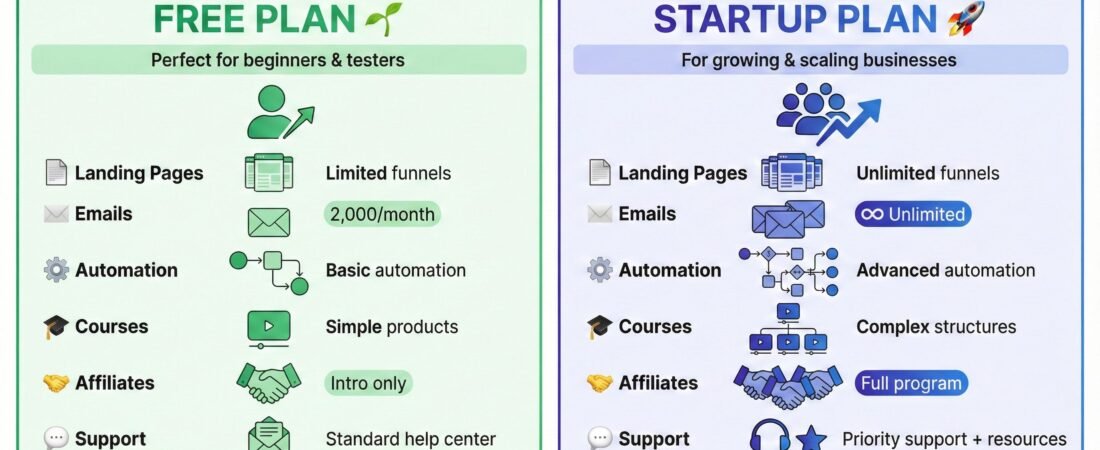
Before we go into details, here is a simple side-by-side view of the two plans. Exact limits may change over time, so always confirm the latest numbers on the official pricing page, but this table gives you a clear picture of how they compare.
Overview Table
|
Feature |
Systeme.io Free Plan |
Systeme.io Startup Plan |
|
Ideal for |
New entrepreneurs, testers, very small lists |
Growing businesses ready to scale campaigns |
|
Landing pages / funnels |
Limited number for basic campaigns |
Much higher or unlimited numbers (depending on current offer) |
|
Emails per month |
Limited email sends (good for small lists) |
Higher or unlimited sends suitable for larger audiences |
|
Automation workflows |
Basic automation with limited active workflows |
More advanced automation and more active workflows |
|
Membership / courses |
Basic capabilities to host simple products |
Expanded options for more products and complex structures |
|
Affiliate management |
Intro features or limited use |
More practical for real affiliate programs |
|
Support |
Standard help centre and email support |
Priority or faster support, plus more learning resources |
|
Best use case |
Testing ideas, validating funnels, building first list |
Scaling, running regular launches and building full sales engines |
Best Choice (Quick Answer)
- Choose Free Plan if:
→ You’re testing or learning - Choose Startup Plan if:
→ You want to actually build income faster
If you’re serious about earning, start here:
Inside the Systeme.io Free Plan
The Systeme.io Free plan is designed to remove excuses. You can start building an online business without spending anything on software.
Core Strengths
-
- Landing pages – You can create a small number of landing pages to collect leads and showcase a simple offer or lead magnet.
-
- Email marketing – The free plan allows a limited number of email sends per month, which is enough to nurture a small list and stay in touch with early subscribers.
-
- Basic automations – You can set up at least one active automation sequence, such as a short welcome series for new leads.
-
- Simple funnels – You can connect your landing page, form and email sequence into a basic funnel without extra tools.
Where the Free Plan Works Well
The free plan is a good fit if:
-
- You are testing a new niche or offer.
-
- You are just learning how funnels and email marketing work.
-
- You want to validate that people are willing to sign up before paying for software.
-
- Your list is still small and your campaigns are simple.
In short, the Systeme.io Free plan lets you get experience quickly. It is a safe way to find out what you actually need before upgrading.
Inside the Systeme.io Startup Plan
The Startup plan is built for the moment when you are no longer simply testing – you are ready to grow.
Core Strengths
-
- Higher email limits
You can email a larger list more often without worrying about running out of quota every month. This matters if you run regular campaigns, launches or newsletters.
- Higher email limits
-
- More automation power
You can create more automation rules and workflows. This lets you segment your audience, trigger targeted emails based on behavior, and build more advanced customer journeys.
- More automation power
-
- More pages and funnels
You can build additional landing pages, upsell pages, thank-you pages and complete funnels for different products or audiences.
- More pages and funnels
-
- Better support and extra resources
Startup users usually receive more responsive support and access to extra training materials. This can save hours when you are learning or trying to fix something quickly.
- Better support and extra resources
Where the Startup Plan Works Well
The Startup plan makes sense when:
-
- You have a growing list and need reliable email capacity.
-
- You run several offers (courses, services, or products) at the same time.
-
- You want to automate more of your marketing so you are not sending everything manually.
-
- You care about optimization and want better structure around funnels and follow-ups.
If your business is already bringing in consistent leads or sales, the Startup plan usually pays for itself by giving you more control and leverage.
Pricing and Value for Money
From a budget point of view, the question is not just “How much does it cost?” but “What do I get back from it?”
A simple way to look at it:
Cost vs Value Table
|
Question |
Free Plan |
Startup Plan |
|
Monthly software cost |
No subscription fee |
Fixed monthly fee |
|
Main financial risk |
None – only your time |
Small ongoing cost |
|
Key benefit |
Lets you start and test an idea |
Lets you scale and systemise what is already working |
|
When it feels expensive |
Almost never |
When you do not yet have traffic, leads or an offer in place |
|
When it feels cheap |
When you learn the basics without paying |
When one or two extra sales from your funnels cover the fee |
If you are still figuring things out, staying on the Free plan is completely fine.
Once you have a clear offer and some traction, the Startup plan becomes less of a cost and more of a tool that supports growth. For beginners or if you are new to Systeme.io entirely, read this first:” → Systeme.io affiliate review
Common Use Cases for Each Plan
Typical Free Plan Workflow
A realistic Free plan workflow might look like this:
-
- Create a simple landing page with a lead magnet.
-
- Connect it to a short welcome email sequence.
-
- Collect feedback, refine your message and understand who is signing up.
-
- Run small tests on traffic sources and see what converts.
This is ideal for new entrepreneurs, testers, bloggers or anyone exploring affiliate marketing for the first time.
Typical Startup Plan Workflow
A Startup plan workflow might look like this:
-
- Map out several offers (for example, a free lead magnet, a low-ticket product and a core offer).
-
- Build a full funnel for each offer, with upsells and down sells where appropriate.
-
- Set up deeper automations: tag subscribers, send targeted sequences, follow up with non-buyers.
-
- Drive regular traffic from email, content, and paid campaigns, all handled by the same system.
This suits small agencies, consultants, course creators, SaaS founders and e-commerce brands that are serious about scaling.
Pros and Cons: Free vs Startup
To make the Systeme.io free vs Startup decision even clearer, here is a straightforward pros and cons view.
Free Plan: Pros and Cons
Pros
-
- No monthly fee
-
- Good for learning funnels and email marketing
-
- Enough features to test an idea properly
-
- Very low risk while you experiment
Cons
-
- Limited number of pages, funnels and automations
-
- Email limits may become restrictive as your list grows
-
- Not ideal for managing multiple offers or audiences
-
- You may outgrow it faster than you expect once things start working
Startup Plan: Pros and Cons
Pros
-
- Higher limits that support real growth
-
- More automation options for segmentation and follow-up
-
- Enough room to run multiple funnels at the same time
-
- Better support and usually more learning resources
Cons
-
- Monthly subscription cost
-
- Slightly steeper learning curve if you jump in without a basic funnel in place
-
- Overkill for someone who is not yet clear on their offer or audience
How to Decide Which Plan You Need
Use this simple checklist to choose between the Systeme.io Free and Startup plans.
Stay on the Free Plan if:
-
- You are still defining your niche or offer.
-
- Your email list is small and you send fewer campaigns.
-
- You are learning the basics of funnels, landing pages and automation.
-
- You prefer to validate your idea before taking on any software costs.
Consider the Startup Plan if:
-
- You have a clear, validated offer.
-
- You are starting to feel the limits of the free plan.
-
- You want to run several funnels or products under one roof.
-
- You need more automation to save time and keep follow-up consistent.
-
- One or two extra monthly sales would comfortably cover the subscription fee.
If you are unsure, you can start on the Free plan, build a simple funnel and watch how it performs. When you feel constrained by limits, that is usually the signal that it is time to move up.
Final Thoughts
Choosing between the Systeme.io Free plan and the Startup plan comes down to one thing: the stage of your business.
-
- If you are testing, learning and validating, the Free plan is enough.
-
- If you are growing, launching regularly and managing more than one offer, the Startup plan will give you the structure and capacity you need.
Treat the free plan as your training ground and the Startup plan as your scaling tool. Once you are clear on your goals and numbers, the Systeme.io free vs Startup decision becomes much simpler to make. Visit this article for a comprehensive Review of Systeme.io free plan only.
Also, see how people make money with Affiliate Marketing here.